TradingView Buy & Sell Signals — Dual Engine v2.0
Rany Sniper Signals v2.0 generates two completely independent types of signals. The Fade Engine generates counter-trend mean-reversion signals (verified WR up to 86.7% on 5m). The Normal Engine generates trend-following BUY/SELL signals with Confidence scoring (0–100). Both engines are no-repaint and Candle Gate protected.
Fade Engine Signals — Counter-Trend / Mean-Reversion
The Fade Engine fires when it detects over-extended candles likely to revert toward VWAP. These are not BUY/SELL trend signals — they are fade signals:
- Trigger: Candle extended far from VWAP + extreme RSI + SR zone + SuperTrend + Volume all aligned
- Direction: Against the candle's direction, toward VWAP
- Candle Gate: Filters spike candles — only structurally valid candles produce a label
- Entry buffer: 20% of candle range from the extreme — shown live in panel
- W/L labels: Every historical signal shows W or L. Rolling last 50. Verifiable by anyone.
- Rolling WR observed on 5m (up to, last 50 signals): SPX500 ~86.7% · USDCAD ~86.7% · ETH ~84% · GOLD ~80%+ · SILVER ~77%+ — results vary by market conditions
Normal Engine Signals — Trend-Following BUY/SELL
The Normal Engine fires BUY/SELL labels in the direction of the trend. Unlike the Fade Engine — which targets short snap-back moves toward VWAP — the Normal Engine is built for extended directional moves, giving the trade room to develop with wider TP/SL levels.
- Trigger: SuperTrend + VWAP + RSI + SR Zones all aligned in trend direction
- Confidence Score: 0–100 ranking — focus on 70+ for execution
- Early (LIVE) warning: Appears during candle formation — preparation only, not an entry signal
- Confirmed BUY/SELL: Fixed at candle close — no-repaint, permanent on chart
- Pivot Entry + Invalidation Zone: Every signal includes exact entry reference and risk level
- No-Trade protection: Signals suppressed during choppy/low-confidence conditions
Signal Integrity — Both Engines
- No-repaint: Confirmed signals are fixed after candle close, never altered
- Candle Gate: Validates every candle against close[1] ± ATR — spike candles cleared immediately on every live tick
- Honest stats: Rolling win rates based on realistic entry prices, not theoretical extremes
- Source protected: Invite-only script — logic cannot be copied or modified
Which Signal Type Should You Use?
The choice between Fade Engine and Normal Engine signals is not a preference — it is a function of market regime. In a ranging, mean-reverting market, applying trend-following BUY/SELL signals leads to repeated false entries. In a strongly trending market, counter-trend fade signals go against the dominant flow and produce higher loss rates. The Dual Engine architecture removes this ambiguity: the system reads VWAP position, SuperTrend direction, and RSI behavior to determine which engine is operating in its optimal regime. When conditions are ambiguous or transitional, both engines stay silent — protecting you from low-probability setups.
Why Most TradingView Signal Indicators Fail
The majority of TradingView buy/sell signal indicators apply a single logic to every market condition — generating signals regardless of whether the market is trending, ranging, or in transition. The result is a high volume of signals, most of which are context-inappropriate. Rany Sniper Signals v2.0 was designed from the ground up to solve this: the Fade Engine was built specifically because the Normal Engine showed ~40% win rate in range-bound conditions. Rather than try to force one system to work everywhere, two independent engines were developed and validated separately — each with its own filters, entry logic, and win rate verification.
Verified Win Rates on Real Assets
Every Fade Engine signal on the chart carries a W or L label — win rates are not marketing claims, they are visible to any user directly on TradingView. Rolling stats cover the last 50 signals, calculated using the realistic 20% entry buffer, not theoretical extremes. Rolling live performance observed on 5m (last 50 signals, up to): SPX500 ~86.7% · USDCAD ~86.7% · ETH ~84% · GOLD ~80%+ · SILVER ~77%+ · DAX ~72.4% · TESLA ~73.7%. Results vary by asset, session, and market momentum — win rates on any given day depend on setup quality and market conditions, not a fixed guarantee.
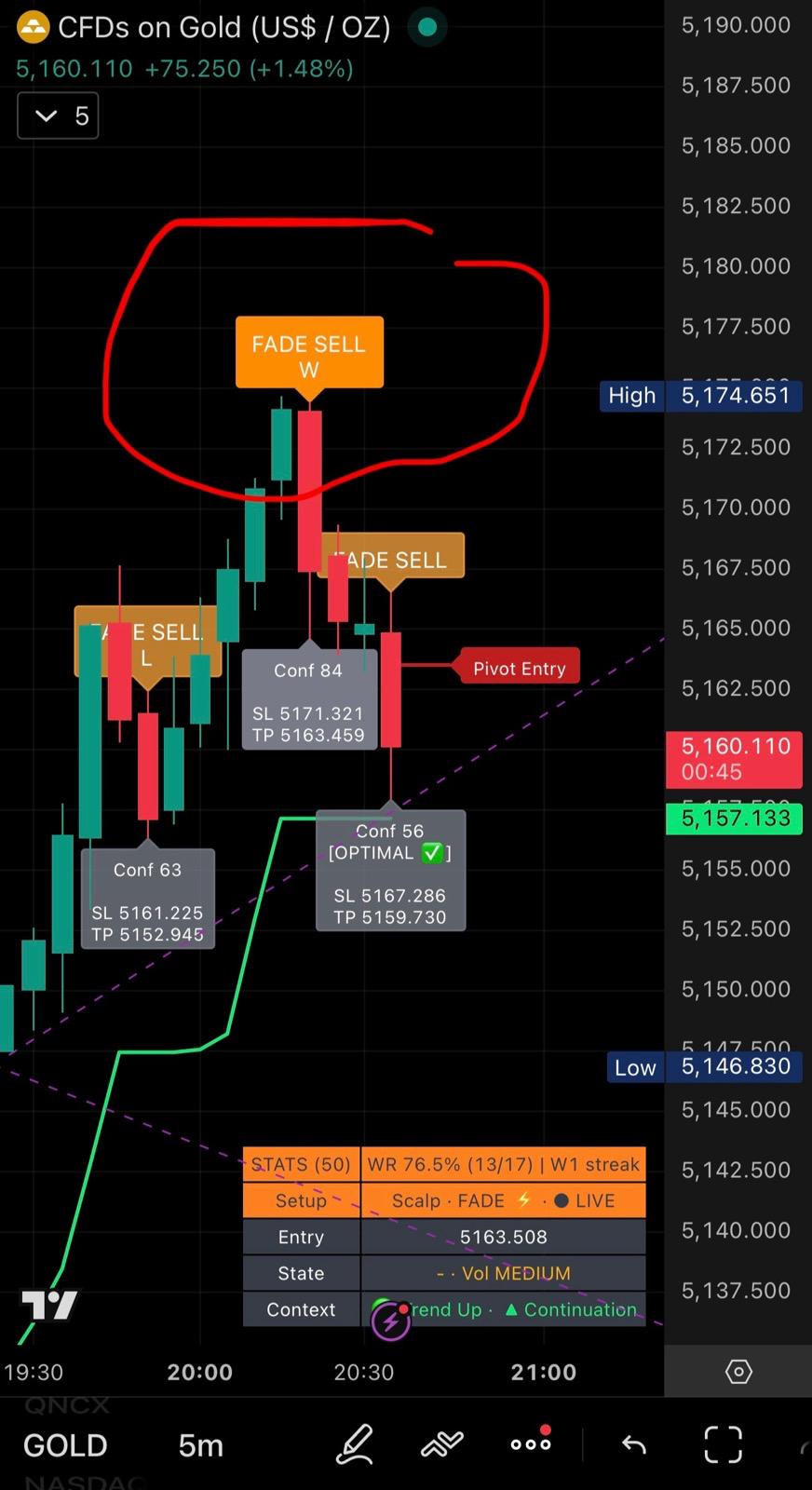 GOLD · 5m
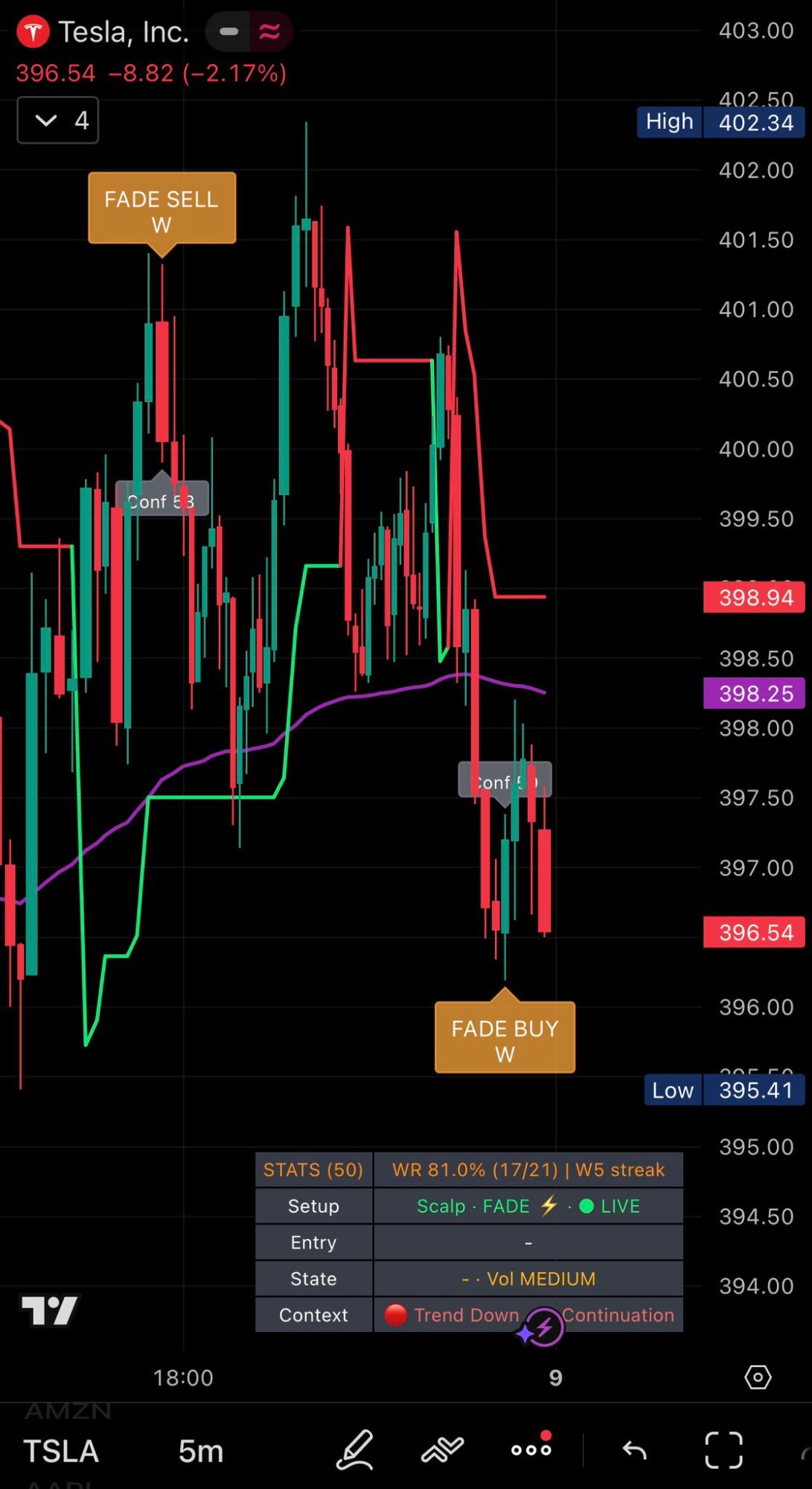 TESLA · 5m
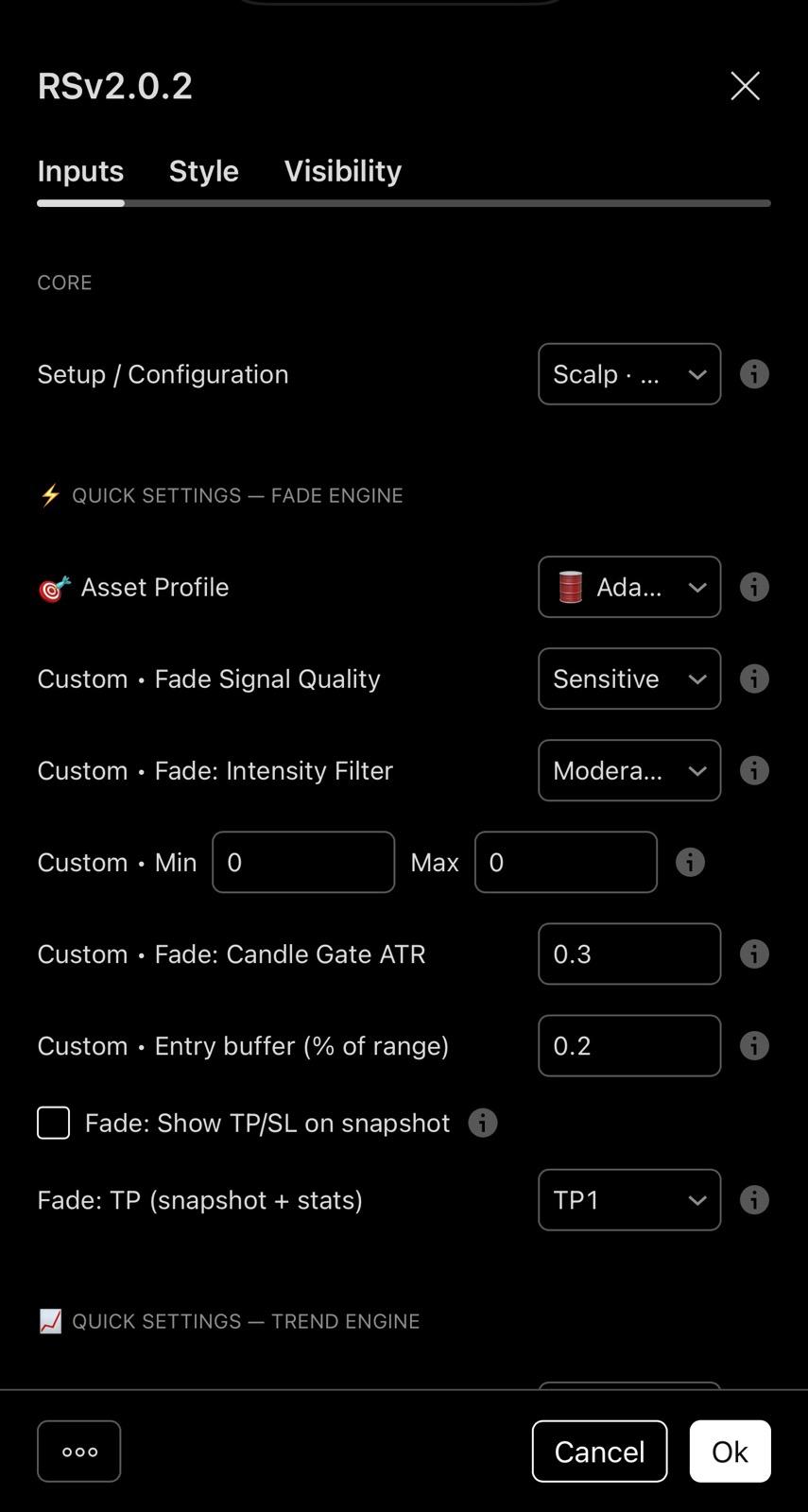 RSv2.0.2 · Settings
Rolling last-50 signals at time of capture · Results vary by asset, session and market conditions · Educational content only.
Educational content only. Trading involves risk. Not financial advice.